Fire Risk Assessment for Flats
A Complete Guide to Fire Risk Assessments for Blocks of Flats
Managing the fire safety of a residential building comes with a unique set of challenges and significant legal responsibilities. Whether you are a freeholder, a Right to Manage (RTM) company, a residents’ management company, or a professional managing agent, ensuring your block of flats has a valid, robust Fire Risk Assessment (FRA) is not just best practice—it is a strict legal mandate.
This comprehensive guide breaks down everything you need to know about fire risk assessments for flats, helping you navigate your legal obligations and keep your residents safe.
Protect Lives and Property
Legal Compliance
Peace of Mind
Prevent Financial Loss
Understanding Your Legal Obligations
In the UK, fire safety in residential blocks is strictly regulated under the Regulatory Reform (Fire Safety) Order 2005, which was substantially clarified and extended by the Fire Safety Act 2021.
Historically, there was often confusion regarding exactly where a landlord’s responsibility ended and a leaseholder’s began. The law now explicitly states that the “Responsible Person” must assess and manage the fire risk for:
- The building’s core structure and external walls (including cladding, insulation, balconies, and windows).
- All common parts, including entrance lobbies, corridors, stairwells, plant rooms, and communal external areas.
- All flat entrance doors that open directly onto communal areas.
Who is the “Responsible Person”?
This is the individual or entity that has control of the premises. It could be the property owner, the landlord, the building manager, or the resident management committee. If you fit this description, you are legally liable for the building’s fire safety compliance.
Key Areas Covered in a Flat Fire Risk Assessment
During a professional assessment, a certified fire safety consultant will systematically evaluate your building to identify potential hazards and evaluate existing protective measures. The core areas analysed include:
- Evacuation Strategy: Verifying whether the building’s design safely supports a “Stay Put” policy (where residents remain in their flats unless directly affected by fire or smoke) or a “Simultaneous Evacuation” policy.
- Compartmentation: Assessing the ability of walls, floors, and ceilings to contain a fire within its room or flat of origin for a specified period (usually 30 to 60 minutes).
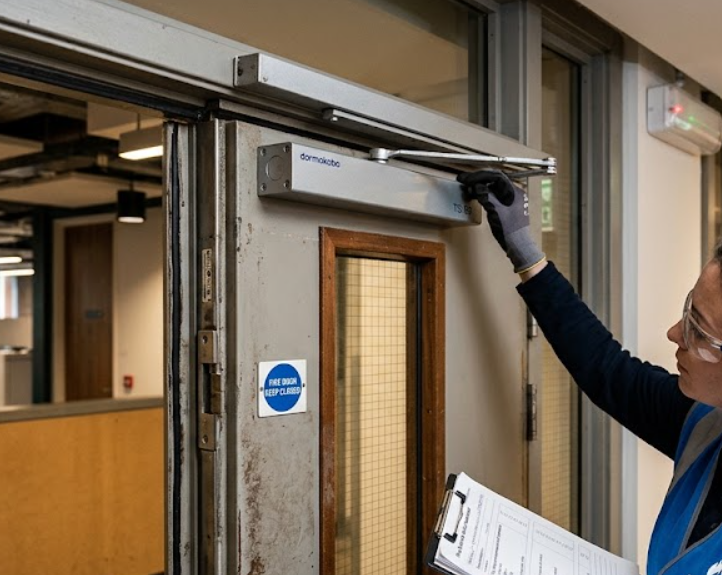
- Flat Entrance Doors: Inspecting front doors to ensure they are certified fire doors fitted with functioning self-closing devices, intumescent strips, and smoke seals.
- Ignition Sources & Housekeeping: Evaluating communal electrical intake cupboards, emergency lighting systems, and ensuring corridors are completely clear of combustible materials or trip hazards.
- Detection & Warning: Checking that communal smoke ventilation systems (AOV) and interlinked alarm systems (where applicable) are fully operational and regularly tested.
Posted on GoogleTrustindex verifies that the original source of the review is Google. Liam at Fire Safety & Compliance has carried out two Fire Risk Assessments for me, one for a commercial property and one for a holiday let. I found him to prompt, conscientious and pragmatic, and very friendly/easy to deal with. In particular, I valued his intelligent approach in relation to our listed building, which enabled us to find appropriate solutions that met the regulations without causing more detriment than necessary to the historic fabric of the building. I would definitely recommend him and use him again.Posted on GoogleTrustindex verifies that the original source of the review is Google. Great thanks place for advice and help with all issues with fire alarms and safetyPosted on GoogleTrustindex verifies that the original source of the review is Google. Highly recommend Liam and his team such a detailed report outlining everything in great detail giving us lots of guidance. Well worth the money and for peace of mind now knowing everything we need to be compliant. Running a small business doesn’t come with a handbook so sometimes getting in the experts in is worth every pennyPosted on GoogleTrustindex verifies that the original source of the review is Google. Liam is an expert in his field, what he doesn’t know isn’t worth knowing! From initial enquiry to completion Liam was prompt, professional, friendly and explained everything along the way. Such a refreshing change to deal with such a professional and knowledgeable expert. I would recommend Liam to any business or Landlord without question. You will be in safe hands. Thanks again Liam.Posted on GoogleTrustindex verifies that the original source of the review is Google. To date this company has provided an excellent all round service.Our contact is ongoing as there are matters that need addressing. I initially spoke to Liam on the telephone. He was able to answer all of the questions I raised clearly and professionally with references to relevant legislation. The contract and pre site visit collection of information was professional and thorough. Communication was clear throughout. His time keeping was faultless. Reports were provided within the promised time frames and were clear and informative. Liam was able to provide reassurance and guidance and recommendations for the remedial work required in respect of our Grade 2 listed building. Explaining at the same time the different standards that applied depending on the proposed use of the building. In addition on request he was able to offer a comprehensive package of site specific fire notices , maintenance logs and procedures. Highly recommended for clarity and knowledge.Posted on GoogleTrustindex verifies that the original source of the review is Google. Liam was very professional, thorough and helpful at every stage - with advance communications, the fire risk assessment itself and follow-up advice and guidance. I can highly recommend.Posted on GoogleTrustindex verifies that the original source of the review is Google. Liam was amazing. We needed a fire risk assessment in order to complete on our flat. He came out within a couple of days, and the assessment was emailed within 2 weeks. Outstanding!!!!Posted on GoogleTrustindex verifies that the original source of the review is Google. Liam’s attention to detail was incredible while visiting the property. So easy to talk to and answer questions, explaining in full detail why fire doors required upgrading, etc. The fire risk assessment itself was incredibly detailed with recommendations clearly explained. I have rung him since the visit on several occasions and he patiently answers all my questions. If you need a fire risk assessment or anything to do with fire safety, Liam is definitely your man. 5 stars from mePosted on GoogleTrustindex verifies that the original source of the review is Google. I am writing this behalf of the Charity I work for. They have been the best company and provided us the report quickly which we wanted for the completion. Professional, very informative, very friendly and accessible company. They agreed to provide us ongoing advice where necessary too. Highly recommend this company.Posted on GoogleTrustindex verifies that the original source of the review is Google. Great Company, good service, very efficient, good value for money and friendly. Will be using them again.
How Often Should an FRA Be Reviewed?
There is no one-size-fits-all expiration date for a Fire Risk Assessment, but the legislation demands that it must be kept up to date. As a general rule of thumb for blocks of flats:
- High-Rise Blocks (Over 18 meters or 7 storeys): Reviewed annually due to the increased complexity and occupant density.
- Low-to-Medium Rise Blocks: Reviewed every 1 to 2 years, or completely redone every 3 years.
An immediate review is legally required if there has been a change in the building’s fabric (such as major renovations), a change in tenant vulnerability, or following a fire incident or “near miss.”
Serving the Southwest
With a proven track record of excellence and client satisfaction, we have established ourselves as a trusted name in the Southwest community. Businesses in the Southwest rely on our expertise, professionalism, and commitment to quality when it comes to fire risk assessments and safety solutions.
- Bristol
- Bath
- Cirencester
- Cheltenham
- Gloucestershire
- South Gloucestershire
- Somerset
- Devon
- Dorset
- Wiltshire
- South Wales
- Monmouthshire
Secure Your Building's Compliance
Failing to maintain a valid Fire Risk Assessment can lead to severe penalties, including heavy fines, invalidation of buildings insurance, and criminal prosecution. More importantly, an inadequate assessment puts lives at risk.
At Fire Safety & Compliance Ltd, our highly qualified, insured assessors hold extensive experience navigating the unique complexities of residential blocks. We provide clear, easy-to-understand reports featuring prioritized action plans so you know exactly what needs to be fixed and when.
Contact our expert team today to request a quotation or schedule a comprehensive Fire Risk Assessment for your block of flats.
Latest News & Insights
Providing Clarity to the Complexity: Stay informed with our insightful blogs of all things fire safety related.