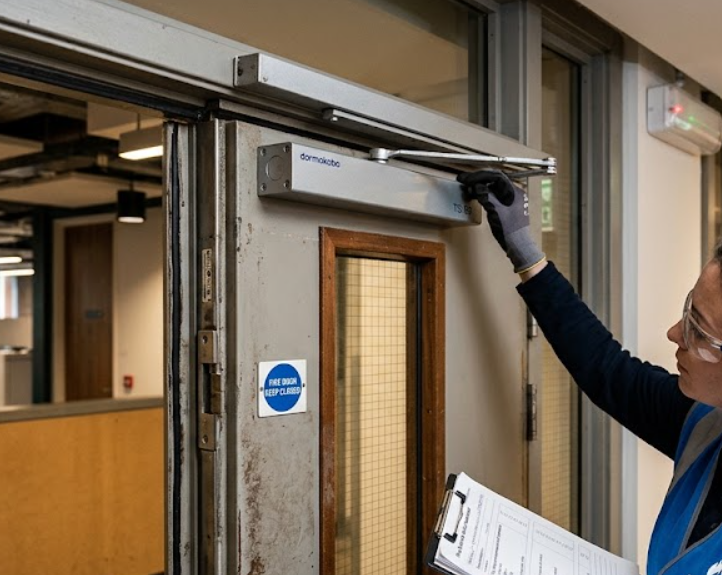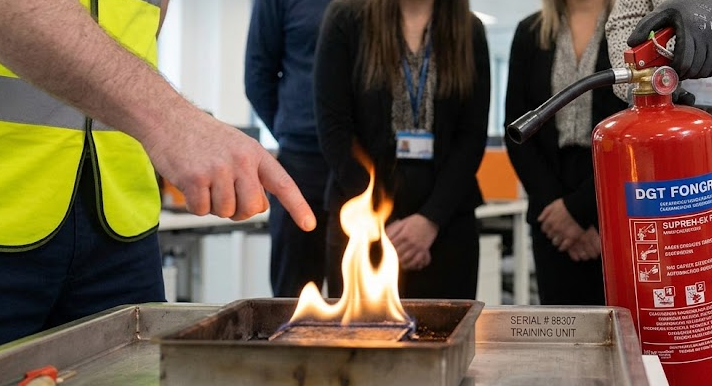
If you are responsible for fire and health and safety across a building, you already know the feeling. The fire risk assessment is a PDF on someone’s laptop. The extinguisher service certificate is in an email from eighteen months ago. The emergency lighting test sits on a paper sheet in a filing cabinet, and the contractor who did your last piece of remedial work sent his insurance details to a colleague who has since left.
Nothing is missing, exactly. It is just in too many places.
That is the quiet problem behind most bad inspections. Not that the work was never done, but that the proof cannot be found when someone asks for it. This is a plain-English guide to pulling it all into one audit-ready system, written by people who used to carry out those inspections themselves.
Why scattered fire safety records put you at risk
Most buildings do not fail compliance because the duty holder ignored it. They fail because the records become unmanageable. The most common symptoms:
- Evidence lost in the gaps. A certificate lives with the contractor, a check lives with the facilities team, and the risk assessment lives with whoever wrote it. No single person can produce the full picture.
- Time lost to the scramble. When an inspector asks “show me”, you spend a day hunting through inboxes, folders and someone else’s filing cabinet instead of answering the question.
- Contractor competence that cannot be proven. You know the work was done. You cannot easily prove the person who did it was qualified, insured and vetted at the time.
- No proof your team read it. Fire safety instructions are only as good as the evidence that staff understood them.
- A bad day instead of a routine visit. Each gap is survivable on its own. Together, they turn a normal inspection into a stressful one.
What “audit-ready” actually means
Audit-ready does not mean a bigger filing cabinet. It means five things are true at any moment:
- Everything lives in one place, not five.
- Every certificate, check and action carries a date and a named owner.
- There is one trail that runs from a risk assessment finding to the action taken to its closure.
- Contractor competence is verified before work is accepted, not after.
- You can prove your team read and signed off on what applies to them.
Get those five right and an inspection stops being a test of your memory. It becomes a demonstration of your system.
How to turn scattered records into one audit-ready system
Step 1: Take stock of everything you hold
Before you consolidate anything, list what already exists. Risk assessments, certificates, servicing records, drill logs, extinguisher and alarm checks, contractor paperwork, staff training records. Do not tidy yet. Just map it, and note where each item currently lives and who owns it. This is your baseline, and it is usually the point where people realise how many disconnected pieces they are carrying.
Step 2: Give every certificate and check one home
Move every item into a single system rather than an assortment of drives, inboxes and folders. Scheduled checks, risk assessment actions, certificates and sign-offs should sit together, in one portal, with one audit trail behind them. The test is simple: if you had to answer an inspector’s question in sixty seconds, could you point to one place?
Step 3: Verify your contractors before they start, not after
Unverified contractors are one of the most common holes in an otherwise tidy file. Use vetted contractors, and make verification part of the job rather than a form you chase afterwards. When competence is confirmed up front, the paperwork proves itself and you are not left reconstructing insurance and qualifications months later.
Step 4: Prove your team read it
Write your fire safety information down and capture the sign-off. Staff acknowledging what they have been told turns a policy on a wall into evidence you can show. It also tells you who has not read it yet, which is the more useful half of the exercise.
Step 5: Rehearse the inspection
Once the records live in one place, walk through them the way an inspector would. Can you produce the current fire risk assessment and the actions arising from it? The latest servicing certificates? Proof of contractor competence? Evidence of staff sign-off? Anything you cannot produce in a rehearsal is the thing that would have tripped you up for real.
What the first 30 days look like
You do not need to fix everything at once. A realistic sequence:
- Map your current records and note every gap and owner. This is your baseline.
- Pick the highest-risk area first, usually the fire risk assessment and its outstanding actions.
- Move certificates and scheduled checks into one system, with dates and owners attached.
- Confirm your contractors are verified rather than assuming they are.
- Turn on staff sign-off, then review the whole picture weekly instead of rebuilding it once a year.
Most duty holders do not need more paperwork. They need one place where the paperwork they already have does its job.
Frequently asked questions
Is this just a tidier filing system?
No. A filing system stores documents. An audit-ready system shows the trail: what was assessed, what was actioned, who did it, and when it closed. The trail is what an inspector is actually looking for.
We look after several buildings. Does this work across all of them?
Yes, and that is where a single system earns its keep. Multiple sites, shared contractors and different responsible people are exactly where scattered records cause the most damage.
We are not a technical team. Is this manageable?
The point is to reduce admin, not add it. A clear portal built around scheduled checks, certificates and sign-offs should feel simpler than the spread of tools it replaces.
Do we have to change our contractors?
Not necessarily. What matters is that whoever works on your buildings is verified and that the evidence is captured in the same place as everything else.
The bottom line
Scattered fire safety records rarely fail because the work was skipped. They fail because the proof is spread across too many places and depends on too many people remembering where things are. Consolidating certificates, checks, risk assessment actions, verified contractors and staff sign-offs into one portal with one audit trail turns your records from a yearly scramble into a system that answers the question before it is asked.
If your fire safety evidence currently lives in too many places, that is exactly the problem your golden thread was meant to solve.

Liam is our founder and Managing Director, bringing nearly a decade of experience in fire safety regulation and compliance across both the public and private sectors.
He holds a Level 4 Diploma in Fire Safety, earned during his time as an Inspecting Officer with his local Fire & Rescue Service. With a strong background in fire strategy development and fire risk assessment, Liam is dedicated to delivering expert guidance that improves building safety.